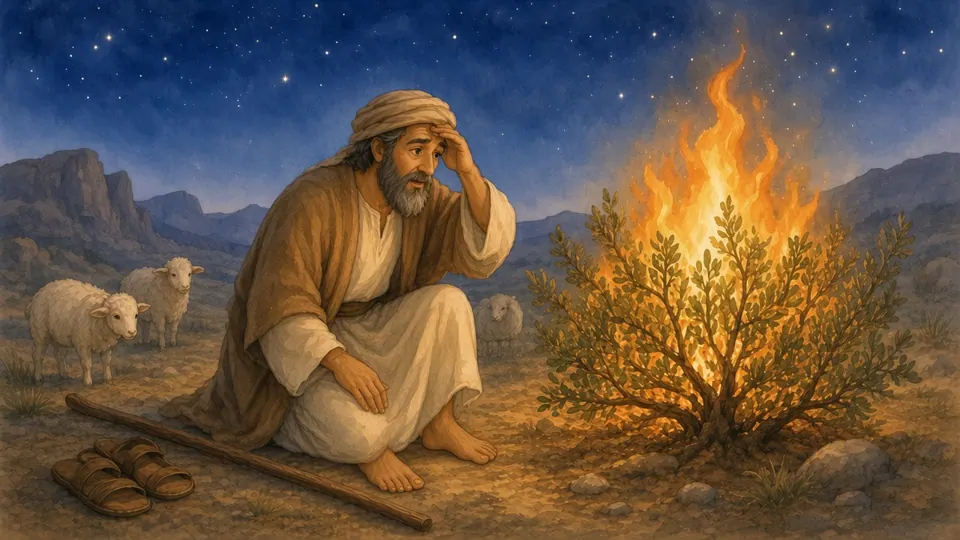
Moses and the Burning Bush
Exodus 3:1–15
Exodus 3 is a turning point for Israel and for theology. Here God speaks his name, and here an ordinary man at an ordinary job is called.
The setting is despair. Israel has been enslaved for generations. Moses, once raised in Pharaoh's household, killed an Egyptian, fled, and settled in Midian. Now he is middle-aged, married, a shepherd for his father-in-law Jethro. Whatever youthful sense of mission he had seems long gone.
He leads the flock deep into the wilderness to Horeb, the mountain of God. There the angel of the Lord appears as a flame inside a bush, and though it burns, it doesn't burn up. Moses steps off the path to look. That small act of attention is the start of everything. God calls him by name, twice. Moses responds. God tells him to come no closer and to remove his sandals, because the place is holy. God names himself as the God of Moses' father and of Abraham, Isaac and Jacob. Moses hides his face.
Then God speaks with a series of verbs that define him: he has watched his people suffer, listened to their cries, understood their pain, and is stepping in to rescue them and bring them to a good land with room to live. Then comes the call: Moses is to go to Pharaoh.
Moses' objection is the honest one: who am I? God doesn't argue about Moses' résumé. He promises his presence, and a sign: the people will worship on this mountain.
Moses asks for God's name. God answers with a name formed from the Hebrew verb to be, which says that God simply is, the source of all that exists, and that he will be there for his people. Then he gives Israel the name, the four letters YHWH, by which he will be remembered forever. Jewish tradition does not pronounce it; Catholic liturgy follows that reverence and uses the LORD. In a letter of 29 June 2008 to bishops' conferences, the Congregation for Divine Worship and the Discipline of the Sacraments directed that the name in the form YHWH not be used or pronounced in the liturgy, in songs or prayers, and that it be rendered as Lord.
The Church reads this as a revelation of God's mystery and nearness at once (CCC 203–207). The name says God is not a being among beings but Being itself, the source of all existence (CCC 213). It also says he is faithful: the God who simply is will be there. The fire that doesn't consume became, for the Church Fathers, an image of God's presence without destruction. Tradition also reads it, beyond the literal sense of the text, as a figure of Mary, who carried God in her womb and remained a virgin: St. Gregory of Nyssa draws this out in his Life of Moses, the Byzantine icon of the Unburnt Bush depicts it, and the liturgy of East and West sings it. Jesus, in John's Gospel, speaks of himself with the divine name (Jn 8:28, 58; CCC 211, 590).
For adult life:
Calls often come in the middle of routine. Moses was working. The question is whether we will stop and pay attention.
Feeling unqualified is normal. In vocation, parenting, leadership or ministry, when we ask who we are to do this, God's answer is almost always the promise of his presence.
God notices suffering. If you are carrying a burden that feels unseen, Exodus 3 says God sees, hears, understands and steps in.
Holiness asks for reverence. Taking off your sandals might look like silence before Mass, a genuflection, or putting the phone away in prayer.
A real-life step: this week, spend ten quiet minutes in a church or adoration chapel. Take off your mental sandals, and ask God where he is sending you.
Talk about it
- Moses was at work when God called him. Where might God be trying to get your attention in your daily routine?
- When you feel unqualified for something God asks, how does his promise of presence change things?
- What does it mean to you that God's name points to his very being and his faithfulness?
- Catholic connection: read CCC 203–209. How can you show more reverence for God's name and presence?
Key verse: Ex 3:14. Look it up in your Bible.
Illustrations created with Grok (AI) and reviewed by our team. Narration voice: Kokoro TTS (AI), Apache 2.0.