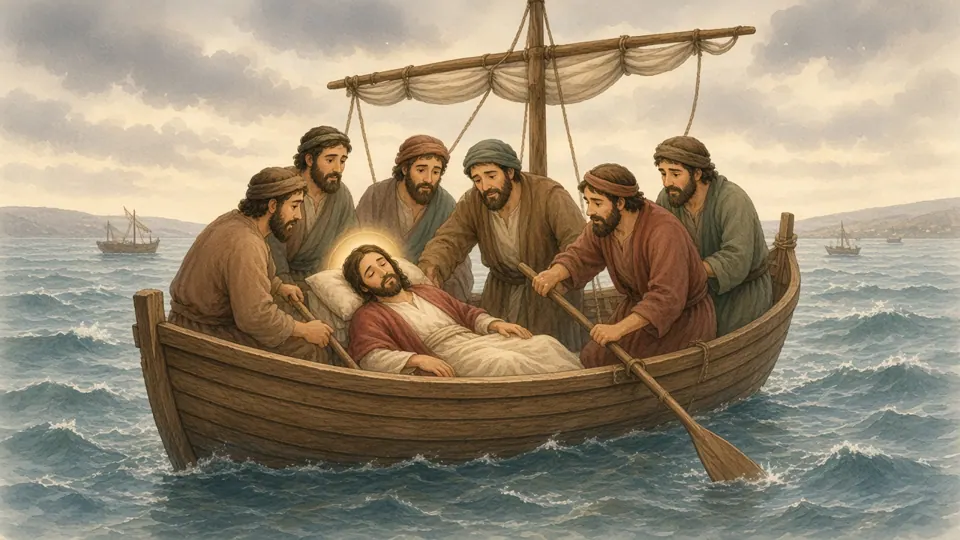
Jesus Calms the Storm
Mark 4:35–41
Mark's account of the storm (Mk 4:35–41) is short and vivid, and it carries details that sound like an eyewitness memory: the evening hour, the other boats, the cushion in the stern. Early Christian tradition links Mark's Gospel to Peter's preaching, and Peter was in that boat. (That link comes from early writers such as Papias; it isn't stated in the Gospel itself.)
The story: after a day of teaching, Jesus has the disciples cross the lake at evening. A furious squall hits; waves break into the boat until it's filling. Jesus sleeps on a cushion in the stern. The disciples wake him with an accusation: as their Teacher, doesn't he care that they're about to die? He gets up, rebukes the wind and commands the sea to be silent and still. The wind stops and the lake goes completely calm. He asks why they are afraid and whether they still lack faith. Overwhelmed with awe, they ask each other what kind of person has the wind and the sea at his command.
Mark doesn't answer their question in this scene. He lets it hang, because his whole Gospel is building toward the answer: Peter's confession that Jesus is the Christ (Mk 8:29), and the Roman centurion at the Cross who recognizes him as the Son of God (Mk 15:39).
What the Church sees here:
Signs of the kingdom. Jesus' miracles are signs that the kingdom of God is present in him and that he is the Son of God (CCC 547–548). They are not magic tricks or ways to impress people; they invite faith (CCC 548).
Divine authority. In Scripture, God alone tames the waters (Ps 89:9; 107:29; Job 38:8–11). Jesus doesn't pray for a miracle as a prophet would; he simply commands. One Person, truly God and truly man: sleeping from human tiredness, then calming the sea with divine authority (CCC 464; 470).
The boat and the Church. Early Christians saw the boat as an image of the Church, carrying believers through the storms of history with Christ on board. That reading belongs to Christian tradition and art, not to the text itself, but it fits Mark's first readers, who faced persecution in Rome.
Honest questions:
Did this really happen, or is it a symbol? The Church holds that Jesus' miracles were real events that also carry meaning (CCC 156; 547). The story is both history and sign.
If Jesus can calm storms, why doesn't he calm mine? Sometimes he does. Sometimes he lets the storm go on and stays in the boat with us. The Catechism says that trust in God as Father is tested, and proves itself, in hard times (CCC 2734). The promise isn't a life with no storms; it's that we never face them alone, and that no storm has the last word.
Is it wrong to be afraid? Fear is a normal human reaction; Jesus himself felt deep distress in Gethsemane (Mk 14:33–34). What he questions is fear that forgets who is in the boat.
St. Augustine once preached that when we are tossed by temptation or anger, it is because Christ is asleep in us, meaning we have forgotten him, and that we should wake him by remembering his word.
A step this week: when you feel anxious, pray one short line, like 'Jesus, I trust in you,' slowly, three times.
Talk about it
- Why does Mark leave the disciples' question without an answer at the end of the scene?
- What does Jesus' power over the sea show about who he is?
- How would you answer a friend who asks why God doesn't stop the storms in their life?
- Catholic connection: read CCC 2734. What does it say about trust in hard times?
Key verse: Mk 4:41. Look it up in your Bible.
Illustrations created with Grok (AI) and reviewed by our team. Narration voice: Kokoro TTS (AI), Apache 2.0.