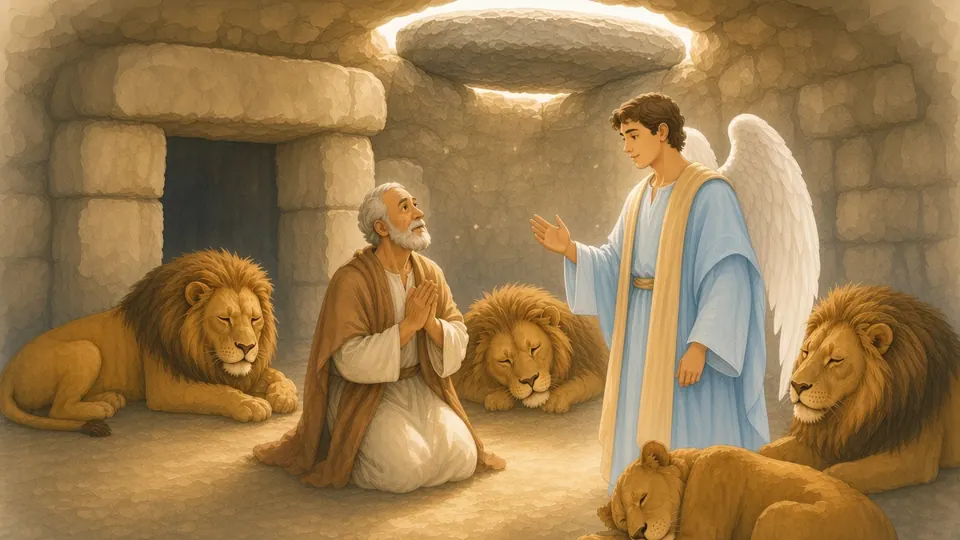
Daniel in the Lions' Den
Daniel 6:1–28
Daniel 6 is the story of a faithful man in a hostile workplace, and it is more adult than its children's-book reputation.
Context: the Book of Daniel is set among Jewish exiles serving foreign empires. Chapter 6 takes place after the fall of Babylon under a ruler called Darius the Mede, a figure not known outside this book; many Catholic scholars read Daniel 1–6 as inspired court stories, and the Church has not defined their literary form (CCC 110). Daniel is old by now, a senior official who has outlasted several regimes.
The story: Daniel is so capable and honest that Darius plans to put him over the whole empire. His colleagues investigate and find nothing, so they go after his faith. They flatter the king into a thirty-day decree that makes prayer to anyone but the king a capital offense, under a law the king cannot revoke. Daniel goes home and prays toward Jerusalem three times a day, as before, without hiding and without theatrics. Darius, trapped by his own vanity, spends a day trying to undo it, then has Daniel thrown to the lions and the den sealed. After a sleepless night he finds Daniel alive, kept safe by an angel God sent. The accusers and their families are thrown to the lions, a pagan king's brutal justice that God's own law forbade (Deut 24:16).
The Church's reading: a citizen must refuse civil commands that contradict the moral order or the Gospel (CCC 2242). Faith is meant to be professed, not only privately held (CCC 1816). And prayer that lasts depends on set times of prayer, so the Church proposes daily rhythms such as morning and evening prayer and the Liturgy of the Hours (CCC 2697–2698).
For adult life:
Integrity at work. Daniel's rivals could find nothing wrong with his work. The strongest witness most of us will ever give is competent, honest work done for years.
Envy is real. Daniel's trouble didn't come from pagans hating God in the abstract; it came from colleagues resenting his promotion.
Leaders can be trapped by flattery. Darius signs something that feeds his ego and then can't undo it. Anyone with authority, at work or at home, should be slow to commit to what flatters them.
Fixed times of prayer. Daniel didn't start praying when the crisis hit; he simply didn't stop. The habit carried him. The Angelus, prayed traditionally morning, noon and evening, is one simple Catholic rhythm.
A saint for this: St. Thomas More, Lord Chancellor of England, a capable and loyal public servant who refused to swear an oath against his conscience and was executed in 1535. He was canonized in 1935, and St. John Paul II named him patron of statesmen and politicians in 2000.
A real-life step: choose three fixed moments in your day for one minute of prayer, and keep them for a week, especially on the busy days.
Talk about it
- Daniel's colleagues could find nothing wrong with his work. What would yours find?
- In what situations are you tempted to keep your faith private to avoid trouble?
- What prayer habits would carry you if a crisis hit tomorrow?
- Catholic connection: read CCC 2698. Which daily rhythm of prayer could you start this week?
Key verse: Dan 6:22. Look it up in your Bible.
Illustrations created with Grok (AI) and reviewed by our team. Narration voice: Kokoro TTS (AI), Apache 2.0.