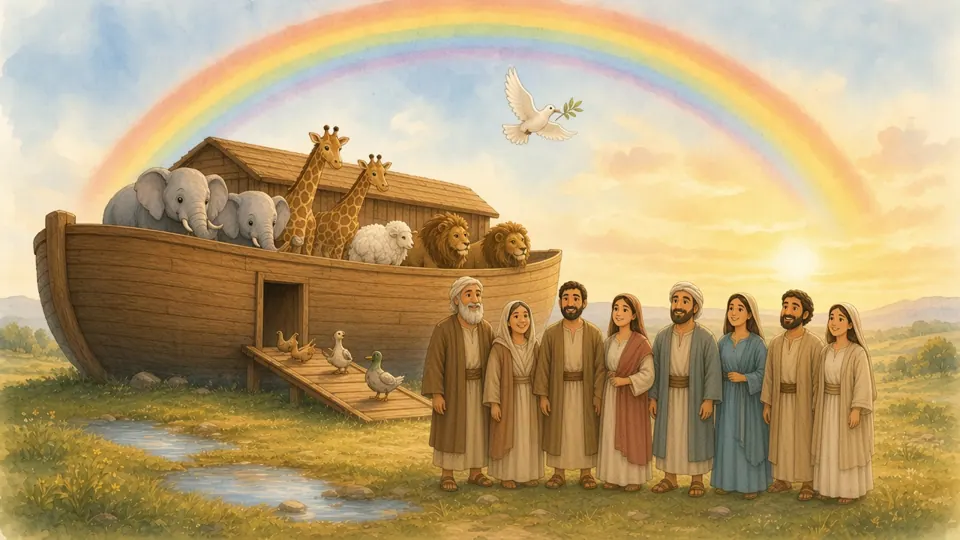
Noah's Ark and the Rainbow
Genesis 6:5–9:17
Genesis 6–9 is told as the story of a world unmade and remade. Read it as an adult and it raises real questions about judgment, mercy and what God does with a world gone wrong.
The set-up is stark. Violence fills the earth. The human heart is described as bent toward evil all day long. God's response, in Scripture's daring human language, is grief and regret (Gen 6:6). The God of the Bible is not indifferent. Evil wounds his creation, and it matters to him.
Against that backdrop stands Noah, an upright man who stayed close to God when his whole world did not. Genesis gives no speeches from Noah. He listens and does exactly what God commands. He builds the ark to God's dimensions, gathers his family and the animals, and goes in. God closes the door.
The Flood undoes creation. In Genesis 1, God separated the waters to make room for life; now the waters above and below rush back together. Everything on dry land outside the ark perishes. Then comes the hinge of the narrative: God had not forgotten Noah (Gen 8:1). A wind passes over the waters, echoing the Spirit over the waters at creation. Dry land appears. A dove returns with a fresh olive twig. A new creation begins.
Noah's first act is worship. God answers with a covenant, unconditional and universal, with all living things: no flood will again destroy all life. The sign is the rainbow. The Hebrew word for it, qeshet, is the ordinary word for a war bow, and many readers see in it a weapon hung up as a sign of peace.
Context: other flood stories survive from the ancient Near East, most famously the Mesopotamian Atrahasis epic and Tablet XI of the Gilgamesh epic. In Atrahasis, the gods send the flood because the noise of growing humanity disturbs them. Genesis tells its story with a very different theology: one God, just and faithful, grieved by violence, who saves Noah and his family and binds himself to all living things by a covenant. The Church reads Scripture with attention to the literary forms of its time (Dei Verbum 12; CCC 110).
The Church reads the covenant with Noah as God's commitment to all nations (CCC 56–58). Fathers of the Church saw the ark as a figure of the Church and the Flood as a figure of Baptism, where sin is drowned and new life begins (CCC 845, 1219; 1 Pt 3:20–21). Jesus himself points to the days of Noah as a warning to stay awake (Mt 24:37–39).
For adult life:
Sometimes faithfulness looks like Noah's: quiet, long obedience while everyone around you treats something else as normal. Raising a family, keeping your integrity at work, or staying chaste can feel like building a boat on dry land.
Grief over evil is not weakness. God grieves. Adults who have walked through a divorce, an addiction in the family, or injustice at work can bring that grief to God honestly.
There is always a new beginning after the flood. The sacraments of Baptism and Reconciliation are God's way of saying that again and again.
A real-life step: the next time you see a rainbow, pray for someone who is going through a flood of their own, and tell them you did.
Talk about it
- Noah obeyed for a long time without seeing the reason. Where is God asking you for that kind of faithfulness?
- God grieves over violence and evil. How does that change the way you bring your own grief to him?
- How does seeing the Flood as a picture of Baptism change the way you read the story?
- Catholic connection: read CCC 56–58. What does the covenant with Noah say about God's care for every nation?
Key verse: Gen 9:13. Look it up in your Bible.
Illustrations created with Grok (AI) and reviewed by our team. Narration voice: Kokoro TTS (AI), Apache 2.0.