The Passover and the Red Sea
Exodus 12:1–14:31
After four hundred and thirty years in Egypt, the descendants of Jacob had become a large people, and Egypt had turned them into slaves. An earlier Pharaoh had even ordered their baby boys thrown into the Nile (Ex 1:22). God sent Moses and Aaron to demand their freedom, and nine plagues struck Egypt. Each time Pharaoh hardened his heart and refused.
In Exodus 12, God gives instructions for the night of the last plague. Each household takes a one-year-old male lamb with no defect, slaughters it at twilight, and paints some of its blood on the doorposts and the beam above the door. The family eats the roasted lamb with unleavened bread and bitter herbs, dressed for travel. God says the blood will be a sign: when judgment comes on Egypt, he will pass over the marked houses. The meal is to be kept every year as a feast of remembrance.
At midnight the firstborn of Egypt died, as God had warned, from Pharaoh's own son down to the son of a prisoner, and a great cry of grief rose up across the land. In the night Pharaoh sent Moses and Aaron away with the people. The men alone numbered about six hundred thousand, and their wives and children came too, carrying the bones of Joseph with them. God went ahead of them in a pillar of cloud by day and of fire by night.
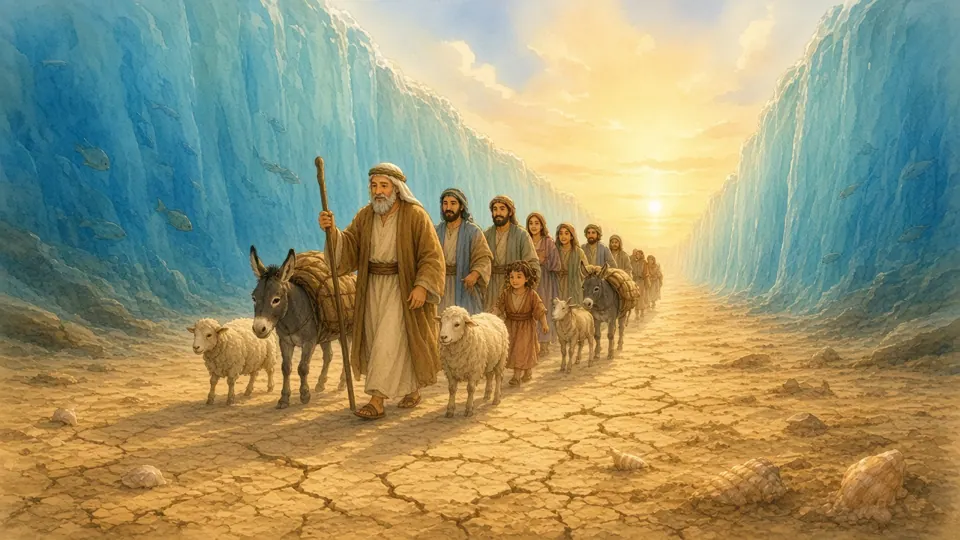
Then Pharaoh regretted letting his labor force go, and he chased them with six hundred of his best chariots. Trapped against the sea, the people panicked and blamed Moses. Moses told them that God himself was about to rescue them; all they had to do was trust him. God told Moses to stop pleading and have the people move forward. The angel of God and the pillar of cloud moved behind Israel, dark toward Egypt and bright toward Israel. Moses stretched his hand over the sea, and all night long God sent a wind out of the east that pushed the water aside. Israel crossed on dry land, with walls of water on either side.
When the Egyptians followed, God made their army panic, and their chariots got stuck. At dawn the sea returned, and the whole army was drowned. Seeing what God had done, the people were filled with awe, and they believed God and the leader he had given them.
Christians see this night again in Jesus. He celebrated his Last Supper at Passover, and Saint Paul calls him our Passover lamb (1 Cor 5:7). Paul also links the sea crossing to baptism (1 Cor 10:1–2): God brings his people through the water from slavery into freedom.
Talk about it
- Why did the Israelites put the lamb's blood on their doors?
- The people were trapped and afraid. What did God do, and what did he ask of them?
- How does the Passover point to Jesus and to baptism?
Key verse: Ex 12:13. Look it up in your Bible.
Illustrations created with Grok (AI) and reviewed by our team. Narration voice: Kokoro TTS (AI), Apache 2.0.