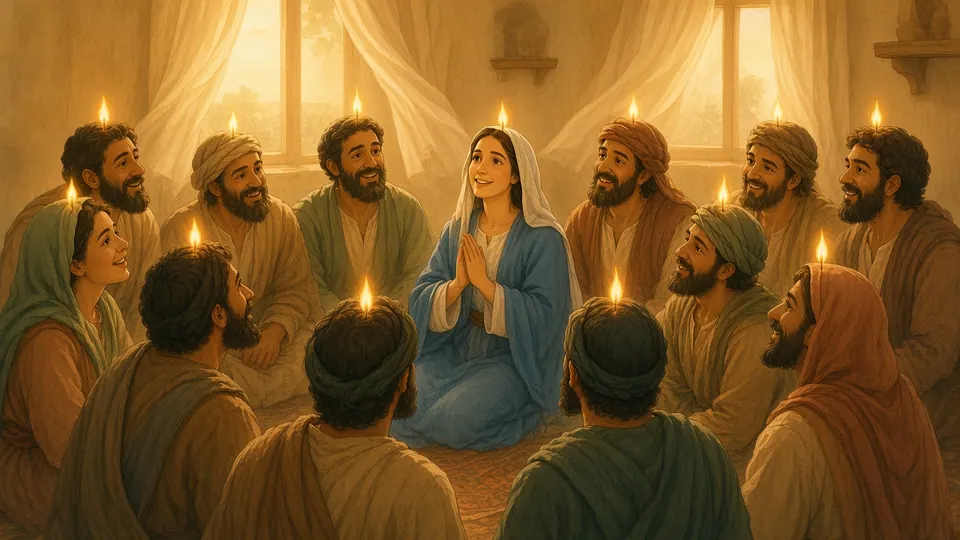
The Holy Spirit Comes at Pentecost
Acts 2:1–41
Pentecost is where the Church stops waiting and starts speaking. The disciples in Acts 2 are not new people with new talents; they are the same frightened men, now filled with someone else's courage.
Context: Pentecost, the Feast of Weeks, was a pilgrimage feast fifty days after Passover, celebrating the wheat harvest. Later Jewish tradition also connected it with the giving of the Law at Sinai. Diaspora Jews and converts filled Jerusalem. Luke had ended his Gospel with Jesus telling the apostles to wait in Jerusalem for power from God, and Acts picks up there: about a hundred and twenty believers, Mary among them, praying together (Acts 1:14).
The story: a sound like a gale fills the house; small flames rest on each person; they speak in languages they never studied. Pilgrims from some fifteen lands hear God praised in their own languages, and some mock them as drunk. Peter, seven weeks after denying Jesus by a fire in a courtyard, stands up in public and preaches: this is Joel's promised outpouring; Jesus, put to death, was raised by God, as the Psalms foretold; the apostles are witnesses; the risen Lord has poured out the Spirit. Shaken, the crowd asks what to do. Peter's answer is conversion and Baptism in Jesus' name, with forgiveness and the Spirit as God's gift, offered to every generation and every nation. About three thousand are baptized.
The Church's reading: Pentecost brings Christ's Passover to its fulfillment, and with it the Trinity is revealed in full (CCC 731–732). That morning the Church stepped into public view and began preaching to the nations (CCC 767; 1076). Baptism has been given since that day (CCC 1226), and Confirmation gives each believer the Spirit in fullness, as the apostles received him that day (CCC 1302; 1288). The Spirit taught the Church to pray (CCC 2623), and Mary, praying with the apostles for the Spirit, was part of the Church's beginning (Acts 1:14; CCC 2617; 726; 965). The seven gifts of the Spirit are given to perfect our virtues (CCC 1831). Peter's words are a call to conversion, never a charge against the Jewish people as a whole (CCC 597).
For adult life:
Courage you don't have. Most adults know what they ought to say or do and freeze. Pentecost is not self-confidence; it is the Spirit acting through people who stay weak.
Unity without uniformity. The crowd heard the Gospel in their own languages. Parishes that hold many cultures, generations and politics are living Pentecost, not managing a problem.
Unfinished Confirmation. Many adults were confirmed young and never thought about it again. The grace has not expired.
A Catholic resource: St. Pier Giorgio Frassati, a young Italian layman canonized on 7 September 2025, lived a joyful, prayerful faith in ordinary student life and served the poor of Turin in secret. The traditional prayer "Come, Holy Spirit" can be prayed anywhere.
A real-life step: pray "Come, Holy Spirit" every morning this week before you check your phone, and ask for one gift by name: wisdom, counsel or courage. If you have never been confirmed, ask your parish about it.
Talk about it
- Where in your life do you need courage you don't have on your own?
- Peter preached seven weeks after denying Jesus. What does that say about God's use of people who have failed?
- How could your parish or family live 'unity without uniformity'?
- Catholic connection: read CCC 1831 on the gifts of the Spirit. Which gift do you most need now?
Key verse: Acts 2:38. Look it up in your Bible.
Illustrations created with Grok (AI) and reviewed by our team. Narration voice: Kokoro TTS (AI), Apache 2.0.