Abraham Trusts God
Genesis 22:1–19
Few passages have unsettled believers as much as Genesis 22. Philosophers have written books about it. It's worth reading slowly and in context.
Abraham's story began with a call to leave everything and a promise: land, descendants and a blessing for all nations (Gen 12:1–3). For twenty-five years the promise seemed impossible. Then Isaac was born, laughter in his name, the fulfillment of everything. Genesis 22 begins by telling the reader up front that what follows is a test. God asks Abraham to take that son, the one he loves, to the land of Moriah and offer him there.
Abraham's response is silence and action. He rises early, cuts wood, travels three days. At the foot of the mountain he tells his servants that he and the boy will worship and return. Isaac carries the wood; Abraham carries the fire and the knife. Isaac's question, where is the lamb, gets a reply that has rung through the centuries: God will see to it. The two walk on together.
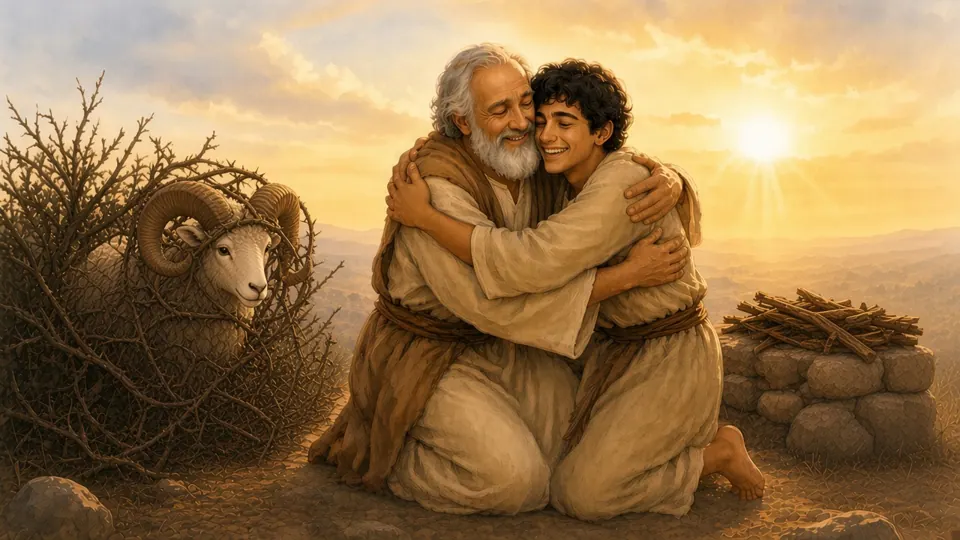
At the summit the angel of the Lord intervenes before any harm is done: Abraham must not touch the boy. A ram is tangled in nearby bushes. Abraham offers it in Isaac's place and names the place The Lord Will Provide. God answers with an oath and renews every promise: countless descendants, and blessing for all nations through Abraham's line.
Context: child sacrifice was practiced among some of Israel's neighbors, and Israel's law and prophets condemn it in the strongest terms (Lev 18:21; Deut 12:31; Jer 7:31). One of the things Genesis 22 teaches is that the God of Abraham does not want it. He stops the hand and provides the offering. Mount Moriah is later identified with Jerusalem's Temple mount (2 Chr 3:1), where countless animal sacrifices would be offered. Jewish tradition calls this passage the Akedah, the Binding.
The Church reads it as a supreme test of faith that foreshadows the Gospel. Hebrews says Abraham believed God could raise the dead (Heb 11:17–19). The Catechism sees the Father's own gift here: Abraham is spared from giving his son, but the Father gives his own (CCC 2572; Rom 8:32). The Fathers of the Church saw Isaac carrying wood up the hill as a figure of Christ carrying the Cross, and St. Augustine saw the ram, held by its horns in the thorny brush, as a figure of Christ crowned with thorns before he was offered (City of God XVI.32). These readings are part of Tradition, not explicit verses (on typology, CCC 128–130).
For adult life:
Most of us will never face Abraham's test, but we all have an Isaac: the child, the career, the marriage, the plan through which we expect God's promises to come. Faith matures when we can hold even our good things with open hands.
This story is also a firm boundary. God does not ask anyone to harm another person. Spiritual leaders who claim otherwise are wrong, and any adult in that situation should seek help.
And for parents: Abraham and Isaac walked up together and came down together. Many parents carry fears for a child's health, faith or future. The God of Moriah sees ahead and provides.
A real-life step: name your Isaac, the good thing you most fear losing, and offer it to God in prayer this week. Then thank him for one way he has already provided.
Talk about it
- What is your Isaac, the good thing through which you most expect God to bless you?
- How does knowing that God stopped Abraham and forbids child sacrifice change the way you read this story?
- Abraham told his servants that he and the boy would come back. What would that kind of trust look like in your life?
- Catholic connection: read CCC 2572 and Rom 8:32. What does Abraham's test reveal about the Father's love?
Key verse: Gen 22:14. Look it up in your Bible.
Illustrations created with Grok (AI) and reviewed by our team. Narration voice: Kokoro TTS (AI), Apache 2.0.