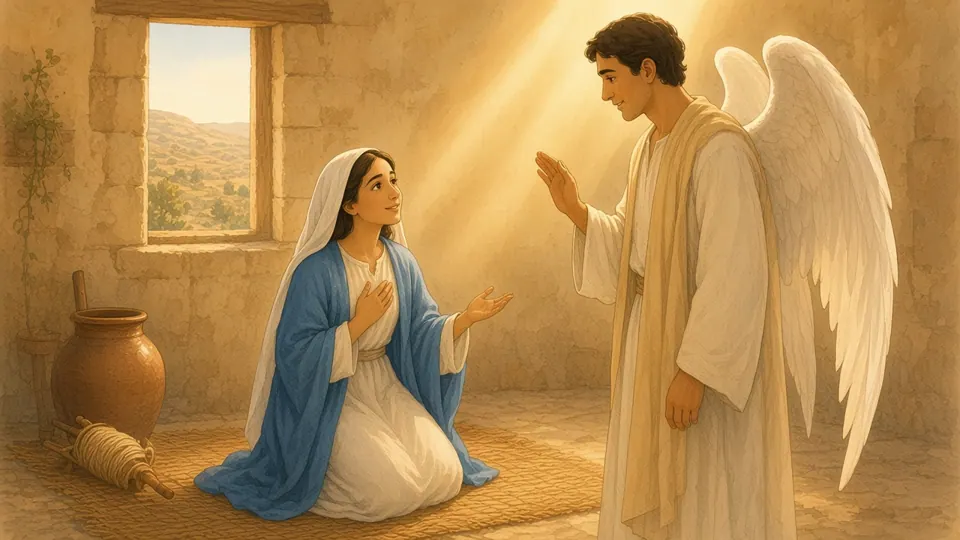
Mary Says Yes to God
Luke 1:26–56
Two scenes, one chapter: an angel's announcement in a Galilean village, and a meeting of two pregnant women in the hill country. Between them lies the central claim of Christianity: God became a human being, and he did it by asking a young woman's consent.
The story: the angel Gabriel is sent to Nazareth, to Mary, a young woman betrothed to Joseph of David's line. He greets her as "full of grace" and announces that she is to be the mother of Jesus, the promised king from David's line and the Son of the Most High. Mary, still a virgin, asks how this is to happen. Gabriel answers that no man will be involved: the child will be conceived by the Holy Spirit through God's power, and he will be God's own holy Son. Her elderly relative Elizabeth, long unable to have children, is six months pregnant, a sign that there is no limit to what God can do. Mary consents freely and gives herself to God's plan. She then hurries to Elizabeth. At her greeting, Elizabeth's unborn son stirs with joy, and Elizabeth, filled with the Spirit, calls Mary blessed and the mother of her Lord. Mary responds with the Magnificat, a song about a God who overturns the world's ranking of the powerful and the lowly.
What the Church sees here: the Annunciation opens the fullness of time (CCC 484). Gabriel's greeting shows that Mary was prepared by God's grace to give a free yes (CCC 490), and the Church teaches, as the dogma of the Immaculate Conception defined in 1854, that from the first moment of her conception she was preserved from original sin, by a unique grace of God and by the merits of her Son (CCC 491–492). This is a defined dogma of the Church (Pope Pius IX, Ineffabilis Deus), rooted in Tradition. Luke does not narrate it, and no verse states it outright; its key scriptural text is Gabriel's greeting, "full of grace," read within the whole Tradition (CCC 490–493). Her answer is the model of the obedience of faith (CCC 148; 494). Because her son is God the Son, Elizabeth's title for her, mother of my Lord, grounds the Church's title Mother of God (CCC 495). Jesus was conceived by the power of the Holy Spirit, not by a human father (CCC 496–497). Mary's visit carries God to his people, and John, still unborn, welcomes him (CCC 717; 523). The Magnificat is the song of the Church as well as of Mary (CCC 2619).
Honest questions:
Do Catholics worship Mary? No. The Church honors Mary with a special love, but that honor is essentially different from the adoration given to God alone, and it leads to Christ (CCC 971). Every Marian title is about her Son.
Was Mary forced? No. Gabriel announces and explains; Mary asks a real question and then freely agrees. The Church Fathers loved to contrast her obedience with Eve's disobedience (CCC 494).
Why does an unborn baby's joy matter? Luke presents John, still in the womb, responding to Jesus, still in the womb. The Church teaches that human life is sacred from its very beginning, because it comes from God's creative action, and must be protected from the moment of conception (CCC 2258; 2270).
Mary's yes was made without knowing how things would turn out. That is what faith often looks like at your age too: saying yes before you see the whole plan.
Talk about it
- What did Mary ask Gabriel, and how is her question different from doubting God?
- Elizabeth calls Mary 'the mother of my Lord.' Why does the Church call Mary the Mother of God?
- The Magnificat says God lifts up the lowly. Where do you see that happening today?
- Catholic connection: read CCC 971. How would you explain the difference between honoring Mary and worshiping God?
Key verse: Lk 1:38. Look it up in your Bible.
Illustrations created with Grok (AI) and reviewed by our team. Narration voice: Kokoro TTS (AI), Apache 2.0.