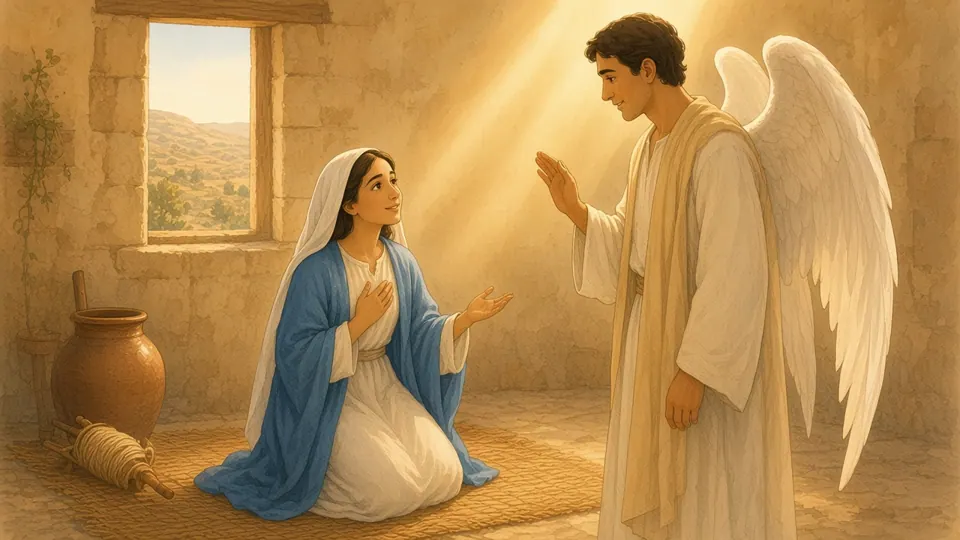
Mary Says Yes to God
Luke 1:26–56
Luke 1 is about God's plan arriving through two women whom the world would barely notice: a young villager in Galilee and an older relative everyone assumed would never have children.
Context: Nazareth was an obscure hill village. Mary was betrothed to Joseph, a descendant of David; betrothal was legally binding, but the couple did not yet live together. Luke sets this scene against Gabriel's earlier visit to the priest Zechariah in the Temple (Lk 1:5–25). The priest in the sanctuary doubts; the young woman in the village believes.
The story: Gabriel greets Mary as full of grace and announces that she will be the mother of Jesus, the Son of the Most High and the king God had promised to David's family (2 Sam 7:12–16). Mary's question is practical, not skeptical: she is a virgin, so how will it happen? The answer is the Holy Spirit and the power of God, and a sign: Elizabeth is pregnant. Mary consents and puts herself at God's disposal. Then she goes, quickly, on a long journey to help Elizabeth. At her greeting, the unborn John stirs; Elizabeth, filled with the Spirit, blesses her as the mother of her Lord and as one who believed. Mary answers with the Magnificat, which echoes Hannah's song (1 Sam 2:1–10) and announces a reversal in which the powerful lose their grip and the poor are raised up.
The Church's reading: here the Word became flesh, conceived by the Holy Spirit and born of the Virgin (CCC 484; 496–497). Mary was readied by grace to give a free and total yes (CCC 490; 494), and the Church professes that she was preserved from original sin from her conception, the dogma of the Immaculate Conception defined by Pope Pius IX in 1854 (Ineffabilis Deus; CCC 491–492). It is a defined dogma, rooted in Tradition; Luke does not narrate it and no verse states it outright, but the Church finds its key scriptural text in Gabriel's greeting, full of grace (CCC 490–493). Elizabeth's words stand at the root of the title Mother of God (CCC 495) and of the second half of the Hail Mary (CCC 2676–2677). Mary's fiat is the pattern of Christian prayer: to belong wholly to God (CCC 2617), and the Magnificat is the song of the whole Church (CCC 2619).
For adult life:
Saying yes without the details. Marriage vows, ordination, religious profession, a child's diagnosis, a move across the country: big yeses are rarely made with full information. Mary asks her question and then trusts.
Faith that goes to help. Mary's first act after the Annunciation is a long trip to care for someone else. Holiness turns outward.
Two generations. Elizabeth and Mary, old and young, bless each other. Parishes need that kind of friendship across ages.
A Catholic resource: the Angelus, a traditional devotion prayed morning, noon and evening, walks through this scene in a minute. St. Gianna Beretta Molla, an Italian physician, wife and mother canonized in 2004, is a modern saint of a costly yes to life.
A real-life step: pray the Angelus once a day this week, at noon if you can. Ask Mary for the courage to say one yes you have been putting off.
Talk about it
- What is a yes you have had to give without knowing how things would turn out?
- Mary's first response to grace was to go and help. Who in your life needs that kind of visit?
- The Magnificat praises a God who lifts up the lowly. How does that challenge the way you measure success?
- Catholic connection: read CCC 2617. What would it mean for your prayer to be a fiat?
Key verse: Lk 1:38. Look it up in your Bible.
Illustrations created with Grok (AI) and reviewed by our team. Narration voice: Kokoro TTS (AI), Apache 2.0.