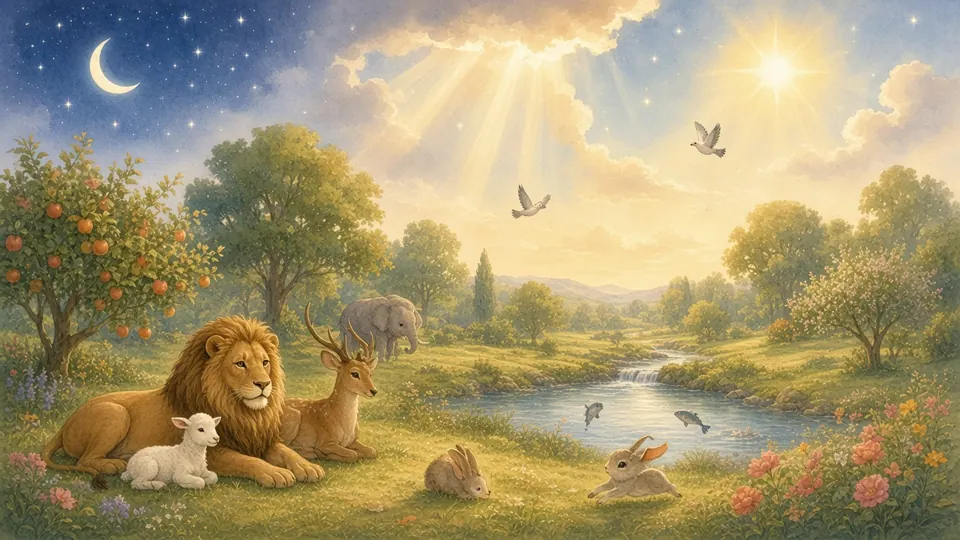
God Makes the World
Genesis 1:1–2:3
Genesis 1 is not the oldest page of the Bible to be written, but it was placed first for a reason: everything else depends on it. Many scholars think it took its final shape when Israel had lost its land and Temple and was living in exile in Babylon. Babylon had its own famous creation story, in which the world was formed out of violence among the gods and human beings were made to serve as the gods' laborers. Genesis tells something completely different.
There is one God, and he has no rival. He doesn't battle chaos; he speaks, and shapeless darkness becomes an ordered, living world. Over six days he separates and then fills: light and darkness, sky and waters, sea and land; then lights for the sky, creatures for the sea and air, and animals for the land. Each stage meets with his approval. The sun and moon, which Babylon worshiped, aren't even named. They are lamps God sets in the sky to mark time.
And human beings are not slaves. God creates them, man and woman together, to be like him: to know, to choose, to love, and to share in his care for the world. He blesses them, entrusts the earth to them and provides for them. Then he surveys all of it and pronounces it supremely good.
On the seventh day God rests and blesses the day. For exiles who had lost everything, that was a radical claim: your worth is not your output, and the God who made the universe invites you to rest in him.
The Church reads this account as true revelation, not as a science report. The Catechism describes the six days as a symbolic presentation of God's work (CCC 337) and insists that faith and honest science can't truly conflict (CCC 159). What the text teaches with certainty goes deeper than chronology: God made everything out of nothing, freely and out of love (CCC 295–296); the world is good and ordered; and each person is willed by God, made in his image, with equal dignity as man or woman (CCC 355–357, 369). The New Testament adds that all things were made through the Son (Jn 1:3; Col 1:16), the one who would later enter his own creation as Jesus.
For adult life, this chapter speaks to at least three things.
Work. God works and delights in what he makes, so honest work, in an office, a kitchen, a classroom or a nursery, shares in his creativity.
Rest. God's rest is the model for ours. Christians keep Sunday, the day of the Resurrection, as a day of worship and real rest from work (CCC 2174–2175, 2184–2185). In a culture that measures people by productivity, keeping Sunday is a quiet act of trust.
Care for creation. Dominion means stewardship, not exploitation (CCC 373, 2415). St. Francis of Assisi called the sun his brother and the moon his sister because he saw them as fellow creatures praising the same Creator.
A real-life step: this week, protect a few hours of Sunday from work and screens, go to Mass, and spend some time outdoors noticing what God made. Gratitude is the natural response to Genesis 1.
Talk about it
- Genesis 1 answered a story in which humans were made to be laborers for the gods. What competing stories about human worth do you hear today?
- What does God's rest on the seventh day say to someone who feels defined by work or productivity?
- Where in your work or home life could you practice care for creation?
- Catholic connection: how could you keep Sunday more fully this month (CCC 2184–2185)?
Key verse: Gen 1:27. Look it up in your Bible.
Illustrations created with Grok (AI) and reviewed by our team. Narration voice: Kokoro TTS (AI), Apache 2.0.