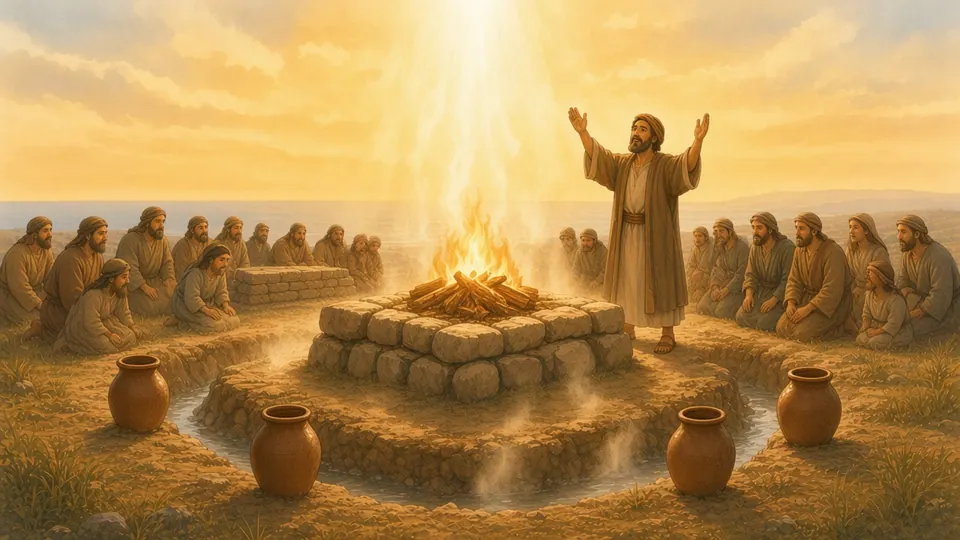
Elijah on Mount Carmel
1 Kings 18:20–39
Elijah lived in the northern kingdom of Israel in the 800s BC, during the reign of King Ahab. Ahab's wife Jezebel, a princess from the coastal city of Sidon, promoted the worship of Baal, a Canaanite god of storms and rain, and she had many of the Lord's prophets killed (1 Kgs 16:31–33; 18:4). God sent a drought that lasted more than three years. Then Elijah had Ahab gather the people at Mount Carmel, along with four hundred and fifty prophets of Baal.
Elijah confronted the crowd. They had been trying to serve both the Lord and Baal, and that could not go on. It was time to choose. The crowd stayed silent.
So Elijah proposed a test. Each side would prepare a bull as an offering and lay it on wood without lighting it. Each would call on its god. The real God would show himself by sending fire. Everyone agreed.
The prophets of Baal went first, since there were so many of them. From morning to noon they called on Baal and danced around their altar, but the sky stayed empty. At noon Elijah mocked them, suggesting that Baal must not be paying attention. They shouted louder. Some even slashed their own skin with blades, a ritual of their religion, hoping to get Baal's attention. They kept up their frenzy until the time of the evening offering. Still nothing happened.
Then Elijah called the people over. He rebuilt the Lord's ruined altar with twelve stones, one for each tribe descended from Jacob, the man God had renamed Israel. He dug a trench around it, arranged the wood, and laid the offering on top. Then he had twelve large jars of water poured over it all, until even the trench was full. No one could accuse him of a trick.
Elijah prayed briefly, calling on the God of Abraham, Isaac and Israel. His prayer had one aim: that the people would recognize the true God and give their hearts back to him.
Fire from the Lord came down. It left nothing behind, not even the stones of the altar, and the water in the trench vanished. The people threw themselves to the ground, and the whole mountainside rang with their confession that Israel's God was the only real God.
The point of the story is not Elijah's power. Fire is God's answer to a short, trusting prayer. Elijah's own name means "The Lord is my God," and that sums up the day. Christians meet Elijah again beside Jesus at the Transfiguration (Mt 17:3), and they meet God's fire again at Pentecost, when the Holy Spirit came on the apostles as tongues of fire (Acts 2:3).
Talk about it
- Why did Elijah have so much water poured over his altar?
- How was Elijah's prayer different from the way Baal's prophets prayed?
- What things can pull people's hearts away from God today, the way Baal did in Elijah's time?
Key verse: 1 Kgs 18:39. Look it up in your Bible.
Illustrations created with Grok (AI) and reviewed by our team. Narration voice: Kokoro TTS (AI), Apache 2.0.