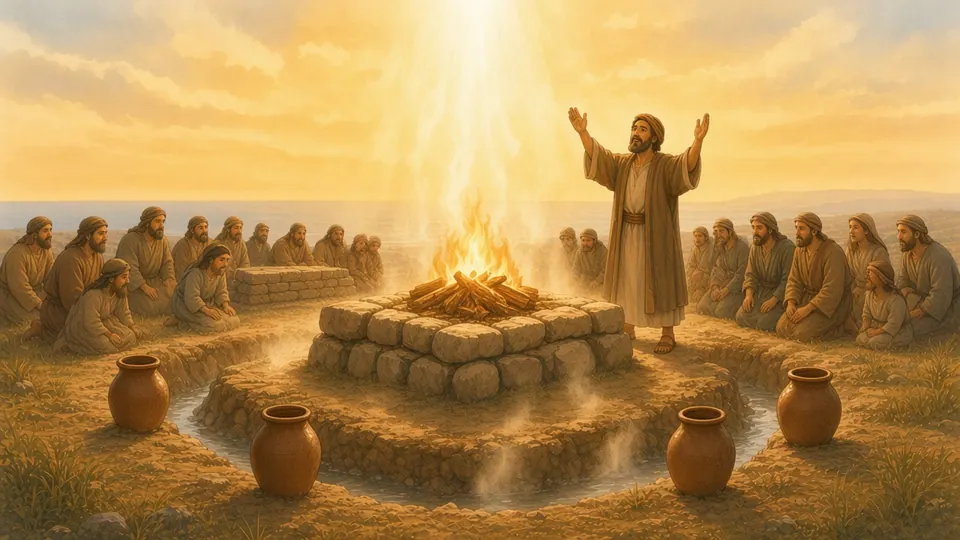
Elijah on Mount Carmel
1 Kings 18:20–39
Mount Carmel is the Bible's most dramatic prayer meeting, but the problem it confronts is quiet and familiar: divided loyalty.
Context: in the ninth century BC the northern kingdom of Israel prospered under King Ahab, who married Jezebel, a princess of Sidon, and built a temple to Baal in his capital, Samaria (1 Kgs 16:31–33). Baal was the Canaanite storm god, believed to send the rain that farmers lived on. Most Israelites had not formally renounced the Lord; they hedged. Then came more than three years without rain.
Elijah confronts the crowd on Carmel: they cannot keep one foot in each camp; they must decide. Silence. He proposes a test with two altars and no fire. Baal's four hundred and fifty prophets cry out for hours, dance, and eventually slash themselves in a ritual frenzy. Nothing comes. Elijah rebuilds the Lord's ruined altar with twelve stones for the twelve tribes, drenches it with water, and at the hour of the evening offering prays a short prayer asking that the people know the true God and turn back. Fire falls and leaves nothing on the altar. The people throw themselves to the ground and confess the Lord as the one true God.
The Church's reading: the Catechism presents Elijah as the father of the prophets and a model of prayer, and Carmel as a decisive test of faith; his name, "The Lord is my God," is what the crowd ends up proclaiming (CCC 2582–2583). The fire is a figure of the Holy Spirit (CCC 696), and the Eastern liturgies echo Elijah's plea in the epiclesis, when the Church asks the Father to send the Spirit on the gifts (CCC 2583; 1105). Idolatry, the Catechism adds, includes making a god of power, pleasure, money or the state (CCC 2113).
For adult life:
Our Baals rarely have altars. They are career, approval, comfort, control, a political tribe. Most of us don't renounce God; we just hedge. Elijah's challenge still lands: whom are you actually counting on for your rain?
Notice the two ways of praying. Baal's prophets work themselves into exhaustion trying to force a response. Elijah prays briefly and trusts. Prayer is not a performance to make God act, and the Catechism warns against treating God as an instrument to be used (CCC 2735).
Notice, too, what comes next. In chapter 19, right after this triumph, Elijah runs for his life, collapses under a bush in the desert and asks to die. God sends an angel with bread and water and lets him sleep (1 Kgs 19:3–8). Burnout can follow spiritual highs, and God's first response is rest and food, not a lecture.
The Carmelite order began among hermits on Mount Carmel around 1200 and honors Elijah as its spiritual father, a tradition of the order rather than a claim of Scripture. Carmelite saints such as St. Teresa of Ávila and St. Thérèse of Lisieux teach a way of prayer that is simple and wholehearted.
A real-life step: name one thing you are hedging with, and give God one undivided minute of prayer each morning this week. At your next Mass, notice the moment the priest holds his hands over the bread and wine and asks the Father to send the Spirit.
Talk about it
- What are you tempted to hedge with instead of trusting God fully?
- Baal's prophets performed; Elijah prayed briefly and trusted. Which describes your prayer lately?
- Have you ever felt drained after a spiritual high, like Elijah in chapter 19? What did you need?
- Catholic connection: read CCC 2113. What does idolatry look like in adult life?
Key verse: 1 Kgs 18:39. Look it up in your Bible.
Illustrations created with Grok (AI) and reviewed by our team. Narration voice: Kokoro TTS (AI), Apache 2.0.