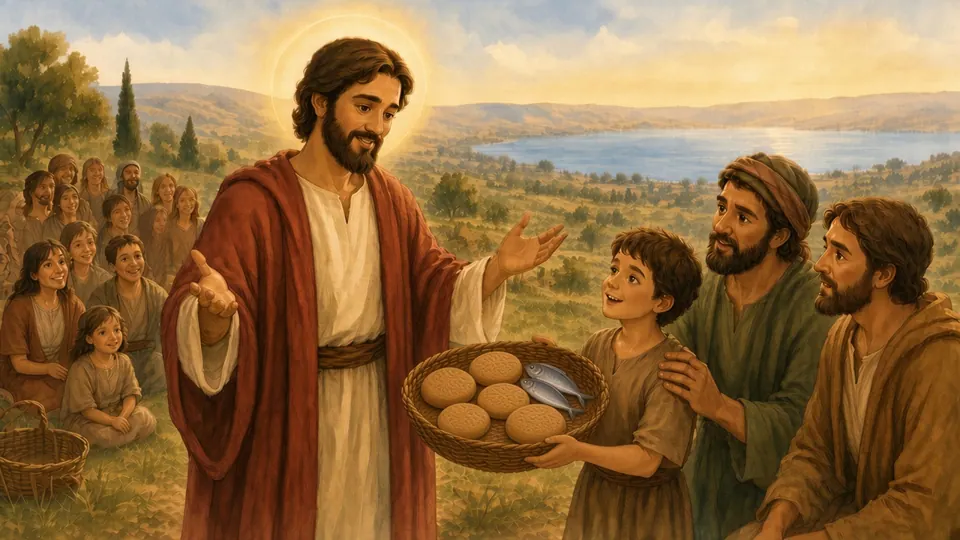
Jesus Feeds Five Thousand
John 6:1–15
John 6 is one long chapter with one big idea: Jesus is the Bread of Life. The feeding of the five thousand (Jn 6:1–15) is the sign; the teaching at Capernaum later in the chapter explains it.
The story: near Passover, Jesus goes up a hillside across the Sea of Galilee, and a great crowd follows. He asks Philip where bread could be bought for them, to test him, since he already knows what he'll do. Philip says even two hundred denarii, most of a year's wages, would fall far short. Andrew mentions a boy with five loaves of barley bread and two fish, and wonders what good they are. Jesus has the people sit on the grass, about five thousand men. He takes the loaves, gives thanks and distributes them, and the fish likewise, as much as people want. Afterward, at his word, the leftovers are collected, with none thrown away: twelve baskets. The people conclude he is the Prophet who was to come, and they want to force him to be king. He slips away from them into the hills, on his own.
What the Church sees here:
A sign of the Eucharist. The actions are deliberate: Jesus takes, gives thanks, and gives. The Catechism reads the multiplying of the loaves as a foreshadowing of the Eucharist: the Lord blesses and gives through his disciples, and the overflowing bread hints at the overflowing gift of his Body (CCC 1335). In John, the sign leads into the Bread of Life discourse, which prepares for the institution of the Eucharist (CCC 1338). There Jesus insists, even as many walk away, that his flesh and blood really are food and drink, given to be eaten and drunk (Jn 6:55, 60–69). The Church believes that in the Eucharist Christ is truly, really and substantially present, Body and Blood, soul and divinity (CCC 1374).
A new Moses, and more. Passover, a mountain, bread in the wilderness and a crowd of God's people: John deliberately echoes the Exodus and the manna. But Jesus is not just another Moses. He is himself the true bread from heaven (Jn 6:32–35).
A different kind of king. The crowd wants a political Messiah who solves their problems. Jesus refuses (CCC 439; 559). His kingship is service, and it will be revealed on the Cross.
Honest questions:
Did it really happen, or did everyone just share their lunch? That explanation is popular, but it isn't what any of the four Gospels say. They all present a real miracle that left people amazed, and the crowd's reaction in John only makes sense if they saw something extraordinary. The Church reads it as a true sign (CCC 547–549).
Is the Eucharist only a symbol? When many disciples objected to Jesus' words about eating his flesh, he did not tell them he was only speaking in symbols; he let them leave rather than water it down (Jn 6:66–67). Peter's reply is the Church's reply: there is no one else to go to, because Jesus' words give eternal life (Jn 6:68).
Why does God let people go hungry today? Jesus feeds the crowd, but he also has his disciples take part. He works through people. Feeding the hungry is one of the corporal works of mercy (CCC 2447).
St. Carlo Acutis (canonized 7 Sept 2025) called the Eucharist his highway to heaven, and as a teenager he built a website cataloguing Eucharistic miracles.
A step this week: go to Mass and, when the priest lifts up the Host, pray silently, 'My Lord and my God.'
Talk about it
- What do Jesus' actions with the bread (taking, giving thanks, giving) have in common with the Mass?
- Why did Jesus refuse to be made king by the crowd?
- How would you answer a friend who says the Eucharist is only a symbol?
- Catholic connection: read CCC 1374. What does the Church mean by the Real Presence?
Key verse: Jn 6:11. Look it up in your Bible.
Illustrations created with Grok (AI) and reviewed by our team. Narration voice: Kokoro TTS (AI), Apache 2.0.