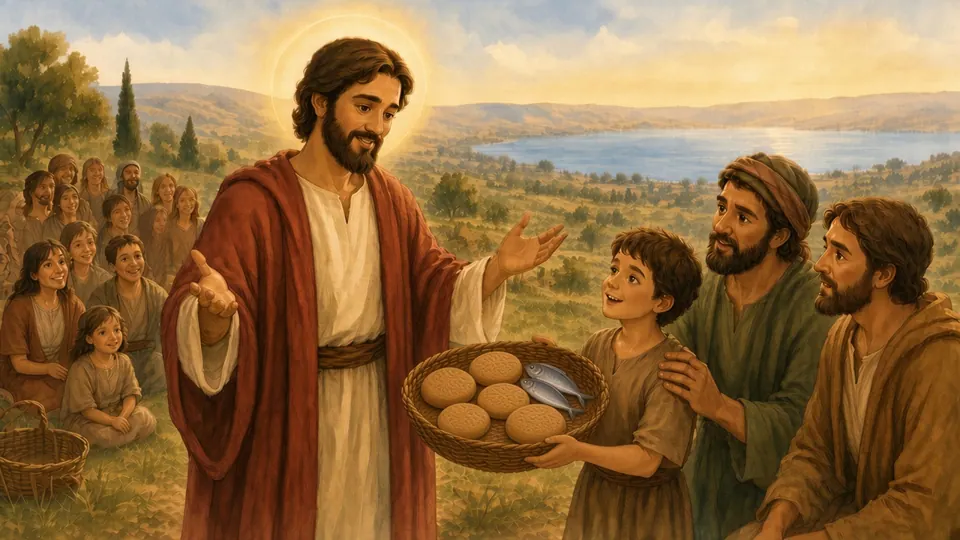
Jesus Feeds Five Thousand
John 6:1–15
The feeding of the five thousand is the only miracle of Jesus' public ministry recorded in all four Gospels (Mt 14; Mk 6; Lk 9; Jn 6). The early Church clearly treasured it. John's telling (Jn 6:1–15) is the most Eucharistic, and the most realistic about the disciples.
Context: The scene is set in the hills on the far side of the Sea of Galilee, in spring: there is green grass, and Passover is near. Two hundred denarii was most of a year's wages for a day laborer. Barley loaves were the bread of the poor. And Passover would have reminded every Jew present of the Exodus: liberation, the journey through the wilderness, and the manna. Many hoped for the prophet like Moses (Deut 18:15), and some later Jewish writings expected the manna to return in the days of the Messiah.
The story: Jesus tests Philip with a question about buying bread. Philip runs the numbers and despairs. Andrew finds a boy with five loaves of barley bread and two fish, and doubts they'll help. Jesus has the crowd sit, about five thousand men. He takes the loaves, gives thanks, distributes them, and the fish too, as much as people want. At his command the leftovers are collected, none of it thrown away, and they fill twelve baskets. The crowd hails him as the Prophet and tries to press him into being their king, and he slips away from them into the hills, on his own.
The Church's reading: the multiplication prefigures the Eucharist, the overflowing gift of the one Bread (CCC 1335), and in John it opens the discourse on the Bread of Life that prepares for the Eucharist's institution (CCC 1338). The Church teaches that Christ is truly, really and substantially present in the Eucharist (CCC 1374), the source and summit of the Christian life (CCC 1324). Jesus' refusal of the crowd's kingship shows that he rejected a merely political idea of the Messiah (CCC 439). Some readers also see in the twelve baskets, gathered by the disciples, a hint of the apostles' lasting role in feeding God's people; that is an interpretation, not a claim of the text.
For adult life:
Small offerings. The boy's lunch was laughably small for the need. Many adults feel that what they bring to God, their time, money, energy and faith, is too little to matter. Jesus works with what is offered.
Philip and Andrew in us. One does the math and despairs; the other finds a resource and doubts it. Both are honest, and both are used. Jesus doesn't need perfect faith, only a willingness to hand him what we have.
Nothing wasted. Jesus' concern for the leftovers is quietly radical. In God's economy nothing good is thrown away, and even our failures can be gathered up and used.
The Eucharist and the poor. The Church insists that the Eucharist commits us to the poor (CCC 1397). Receiving the Bread of Life sends us out to feed others.
St. Teresa of Calcutta (canonized 2016) had her Missionaries of Charity begin each day with Mass and prayer before the Blessed Sacrament before going out to serve the poorest, and she taught her sisters that the Jesus they received in the Eucharist was the same Jesus they served in the poor.
A real-life step: go to one weekday Mass this month, or spend fifteen minutes in Eucharistic adoration. Then do one concrete thing for someone who is hungry: a food pantry donation, or a meal for a neighbor.
Talk about it
- What small thing could you offer God right now?
- Are you more like Philip or like Andrew when you face a big need?
- How should receiving the Eucharist change how you treat the poor (CCC 1397)?
- Catholic connection: read CCC 1324. What would it mean for the Eucharist to be the source and summit of your week?
Key verse: Jn 6:11. Look it up in your Bible.
Illustrations created with Grok (AI) and reviewed by our team. Narration voice: Kokoro TTS (AI), Apache 2.0.