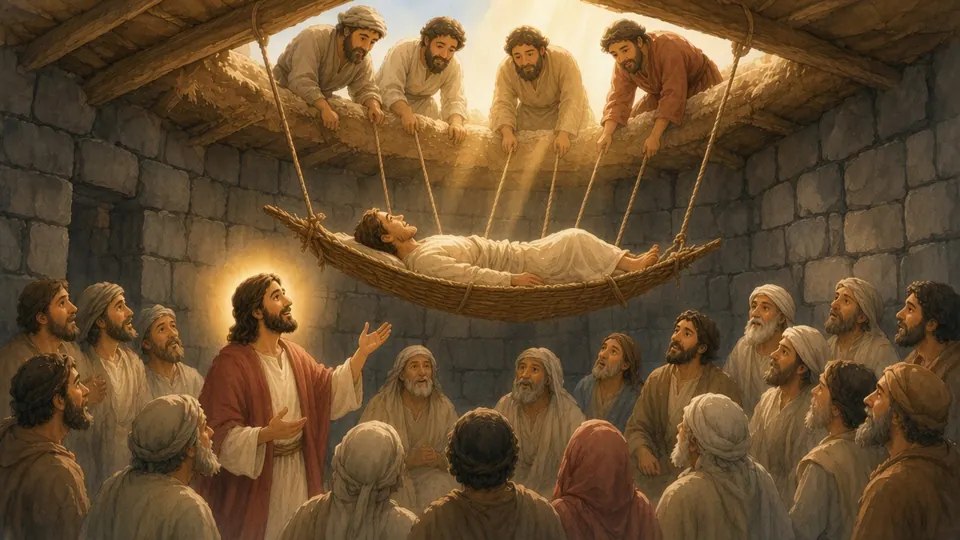
Through the Roof to Jesus
Mark 2:1–12
Early in Mark's Gospel, Jesus is based in Capernaum, a fishing town on the north shore of the Sea of Galilee, probably at the house of Peter (Mk 1:29). When he returns there, word gets out, and the house fills until not even the doorway is clear (Mk 2:1–12).
Houses in Capernaum were small and built of dark basalt stone, with flat roofs made of wooden beams covered with branches and packed clay. That detail explains what happens next.
Four men arrive carrying a paralyzed man on a mat. They can't get through the crowd. So they climb to the roof, dig through the clay and branches above Jesus, and lower their friend down into the room. It's bold and messy, and Jesus doesn't scold them. Mark says that Jesus saw their faith: not just the man's, but his friends' too.
Then Jesus does something no one expects. Instead of healing the man's legs, he speaks to him tenderly, as to a son, and forgives his sins.
Some scribes, experts in the Law of Moses, are sitting there. They say nothing aloud, but inwardly they accuse Jesus of blasphemy, because only God can forgive sins. On that point they are completely right.
Jesus knows their thoughts and challenges them with a question about what is harder to claim: forgiveness, which no one can see, or a healing, which everyone can. Words of forgiveness cost nothing to say, because no one can see whether they worked. Telling a paralyzed man to walk can be tested on the spot. So Jesus does the visible thing to prove the invisible one. To prove that he, the Son of Man, can forgive sins here and now, by God's own authority, he tells the man to stand up and walk home, carrying his mat.
With every eye on him, the man gets to his feet and carries his own mat out the door, and the stunned crowd bursts into praise of God.
Son of Man was Jesus' favorite way of speaking about himself. It comes from the prophet Daniel, who saw a mysterious heavenly figure, one like a son of man, receive glory and kingship from God (Dan 7:13–14). By using that title and forgiving sins, Jesus is making an enormous claim about himself. The scribes understood that, and it is one reason opposition to him began to grow (CCC 589).
Two more points. First, Jesus doesn't say the man's illness was a punishment for his sins. Elsewhere he says plainly that suffering isn't always caused by someone's sin (Jn 9:2–3). He simply heals the deepest need first. Second, Jesus gave his apostles the power to forgive sins in his name (Jn 20:22–23), and through them bishops and priests. That's why Catholics go to Confession (CCC 1441–1442).
Talk about it
- Whose faith did Jesus see, and why does that matter?
- Why were the scribes upset when Jesus forgave the man's sins?
- Why did Jesus heal the man's body after forgiving him?
- How does Jesus still forgive sins today?
Key verse: Mk 2:10. Look it up in your Bible.
Illustrations created with Grok (AI) and reviewed by our team. Narration voice: Kokoro TTS (AI), Apache 2.0.