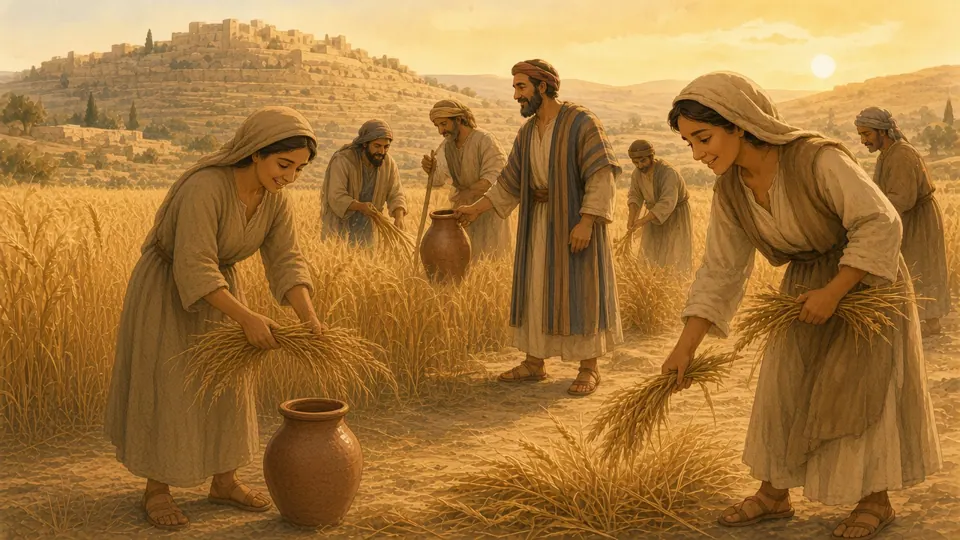
Ruth and Naomi
Ruth 1:1–4:22
Ruth is one of three books of the Bible named after a woman, with Esther and Judith, and its heroine is a foreigner. It is short, but it carries a big message: God's faithful love reaches beyond borders, and he works through people's loyalty and kindness.
The story: in the time of the judges, famine pushes Elimelech and Naomi from Bethlehem to Moab with their two sons. Elimelech dies; the sons marry Moabite women, Orpah and Ruth; then the sons die. Three widows, no sons, no security. Naomi heads home and tells the younger women to go back to their families. Orpah goes. Ruth refuses, and makes one of the most famous commitments in Scripture: she ties her whole life to Naomi's and takes the God of Israel as her own, sealing it with a solemn oath in the Lord's name.
Why this matters: Moab and Israel had a long, tense history, and Deuteronomy barred Moabites from Israel's assembly (Deut 23:3). Yet a Moabite woman is the model of faithfulness here, and she becomes King David's great-grandmother. The book does not erase Ruth's background; it keeps calling her Ruth the Moabite. Belonging to God's people is about faith and loyal love.
In Bethlehem, Ruth gleans in the fields, as the law allowed the poor and foreigners to do. She ends up in the field of Boaz, a relative of Elimelech, who treats her with generosity and respect, protects her from harassment, and blesses her in God's name. Naomi sees God's hand and hatches a plan. Ruth goes to the threshing floor at night and asks Boaz to take her under his protection, a formal request that he act as the family's redeemer and marry her. The scene is bold, but the text presents both of them as honorable: Boaz praises her loyalty, protects her reputation, and sends her home at dawn with a gift of barley. He then follows the law openly at the town gate, where a closer relative declines, and Boaz marries Ruth.
What the Church sees here: Ruth is among the holy women of the Old Covenant whom God used, against expectation, to prepare for Mary (CCC 489). Matthew includes her in Jesus' genealogy (Mt 1:5), a sign that the Messiah's family already embraced the nations, to whom the Kingdom is open (CCC 543). The book's key word is the Hebrew hesed, steadfast covenant love, shown by Ruth, by Boaz, and by God.
Honest questions:
Was the threshing floor scene inappropriate? Some readers find it suggestive, but the text goes out of its way to show restraint and honor. Boaz praises Ruth's virtue, and everything is settled publicly before marriage.
Isn't Ruth just a story about a woman needing a man to save her? Ruth is the one who acts first: she commits to Naomi, works in the fields, and asks Boaz to act. Boaz is generous, and their marriage serves the whole family.
Where is God, if there are no miracles? He is in the harvest, in the law that protects the poor, and in people's faithfulness. Most of our lives look more like Ruth than like the Red Sea.
Talk about it
- Ruth was a Moabite, an outsider. What does her story say about who belongs to God's people?
- How would you answer someone who says Ruth is only about a woman needing a man?
- Where do you see God working quietly in this story, and in your own life?
- Catholic connection: read CCC 489. How do women like Ruth prepare the way for Mary?
Key verse: Ruth 1:16. Look it up in your Bible.
Illustrations created with Grok (AI) and reviewed by our team. Narration voice: Kokoro TTS (AI), Apache 2.0.