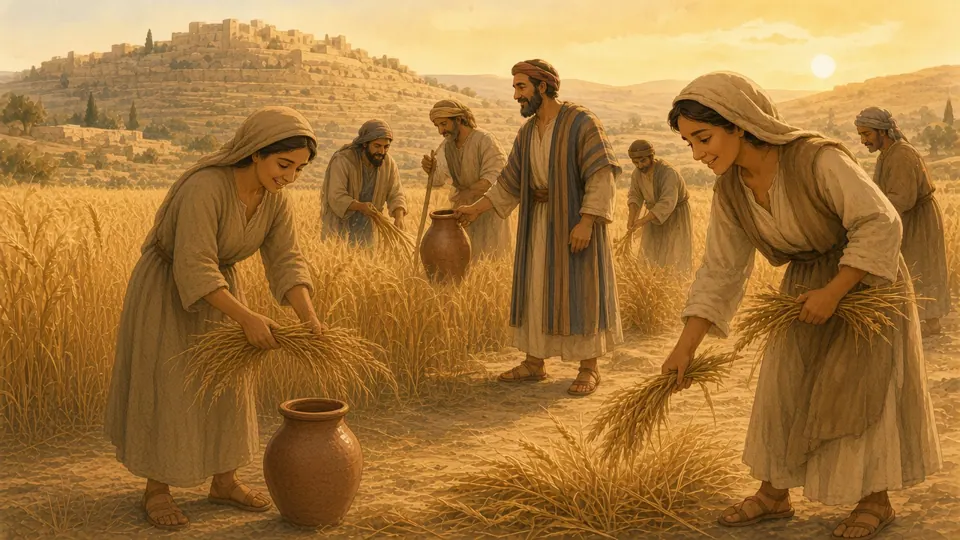
Ruth and Naomi
Ruth 1:1–4:22
The Book of Ruth fits in four chapters and moves from emptiness to fullness. It begins with famine and three funerals and ends with a harvest, a wedding and a baby. In between, almost everything happens through ordinary faithfulness.
Context: the story is set in the time of the judges, when Israel was unstable and often violent. Moab, across the Dead Sea, was a neighbor with a long and tense history with Israel, and Deuteronomy excluded Moabites from Israel's assembly (Deut 23:3). Widows without sons had almost no legal or economic security. Israel's law did make some provision: the poor, foreigners and widows could glean what the harvesters left (Lev 19:9–10; Deut 24:19), and a close relative, the go'el or redeemer, was expected to protect a family's land and name.
Naomi, widowed and childless in Moab, heads home and releases her daughters-in-law. Orpah goes back. Ruth binds herself to Naomi for life and takes the God of Israel as her own, with a solemn oath in the Lord's name. It is a choice of faith, and a choice of costly love for a grieving older woman who has nothing to offer.
In Bethlehem, Naomi is honest about her bitterness; she wants to be called Mara. Ruth goes to work gleaning and lands in the field of Boaz, who turns out to be a relative. Boaz is generous beyond what the law requires: protection, water, a place at the meal, extra grain left deliberately. Naomi, hope stirring, sends Ruth to the threshing floor at night to ask Boaz to act as redeemer by marrying her. The scene is daring, but the narrator shows only honor. Boaz praises Ruth's virtue, guards her reputation, and settles the matter in public at the gate, where a nearer relative steps aside. They marry, and God gives them a son, Obed, the grandfather of David.
The Church's reading: Ruth is among the faithful women of the Old Covenant through whom God prepared for Mary (CCC 489), and Matthew names her in the genealogy of Jesus (Mt 1:5), a sign that the Messiah's family includes the nations, to whom the Kingdom is open (CCC 543). The book's key word is hesed, loyal covenant love, the kind of love God has for us.
For adult life:
Ruth is a book for in-law relationships, blended families and caregiving. Ruth chose to care for an older relative when it cost her everything. Many adults today are caring for aging parents; the Church calls this part of honoring them (CCC 2218).
Naomi's bitterness is not edited out. Grief can make us feel empty and even angry at God. Scripture lets her say so, and still brings her to joy.
For anyone dating or discerning marriage, Boaz and Ruth show a love built on character, respect and public commitment, not on impulse.
A real-life step: this week, call or visit an older relative or a widow in your parish. You may be the way God answers someone's prayer.
Talk about it
- Who is the Naomi in your life, someone who needs your loyal love right now?
- Naomi admitted her bitterness. How can honesty with God be a step toward healing?
- What do Ruth and Boaz show about how to build a marriage or a relationship?
- Catholic connection: read CCC 2218. How does caring for aging parents honor God?
Key verse: Ruth 1:16. Look it up in your Bible.
Illustrations created with Grok (AI) and reviewed by our team. Narration voice: Kokoro TTS (AI), Apache 2.0.