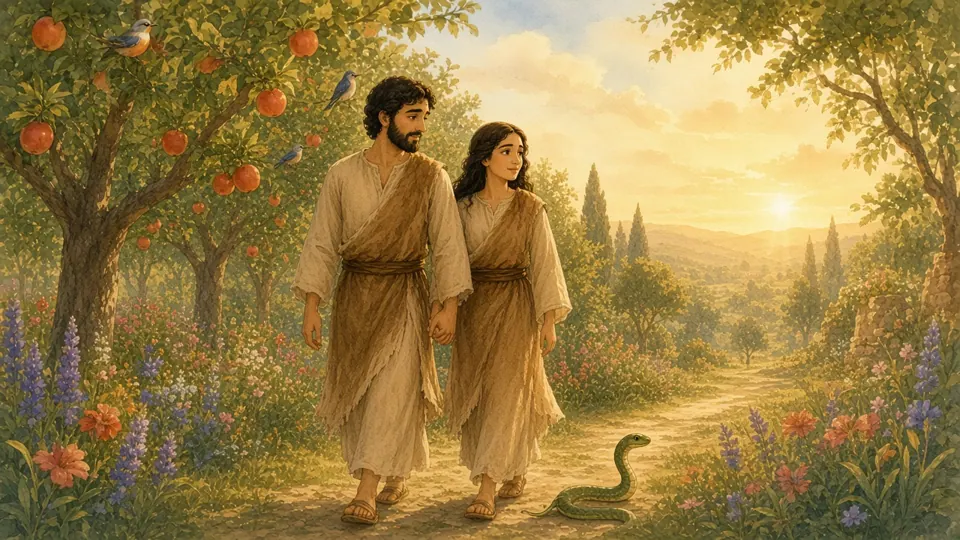
The First Sin and God's Promise
Genesis 3:1–24
Every adult knows the world is not as it should be. Genesis 3 explains why, not with a theory, but with a story about trust.
In Genesis 2, God gives the man and woman a garden, work, each other, and a single limit: the tree of the knowledge of good and evil. The limit is a kindness. It reminds a creature that it receives life and meaning from Someone else. The serpent's strategy is to make that kindness look like control. First it overstates the command, as if God had forbidden every tree. Then it contradicts it: you won't die. God simply doesn't want rivals. Notice what the temptation offers: not just pleasure, but autonomy, the power to define good and evil for oneself.
Eve sees the fruit as good to eat, beautiful, and promising insight. She eats, and Adam, who has been beside her and silent, eats too. What follows is the first experience of guilt: they see their nakedness and are ashamed. Intimacy turns into self-protection. They make coverings from fig leaves and hide in the garden when God approaches in the evening breeze.
God's response begins with a question, not a sentence: he asks the man where he is. It is the question of someone who wants to be found. Adam answers with fear, then deflects onto the woman, and even onto God for giving her to him. Eve points to the serpent. It's a pattern most of us recognize from our marriages, our workplaces and our own consciences.
The consequences are spelled out. Childbearing will be painful; the relationship between husband and wife will be strained by desire and domination; work will become toil against a resistant earth; and humans, taken from the soil, will return to it. They leave the garden, and the way to the tree of life is guarded.
Yet mercy is woven through. God tells the serpent that it and the woman will be enemies, and so will her children and its brood, with the woman's offspring crushing its head while suffering a wound to the heel. And God makes them clothes from animal skins. He clothes the people who tried to cover themselves.
The Church reads this chapter as figurative language about a real event at the beginning of human history (CCC 390). The first sin was a refusal to trust God's goodness, a misuse of freedom (CCC 397–398). The result is original sin: not personal guilt, but a human nature deprived of original holiness and wounded, prone to sin, which the Church calls concupiscence (CCC 404–405). Gen 3:15 is called the Protoevangelium, the first announcement of the Redeemer; Tradition sees in it Christ, the new Adam, and Mary, the new Eve (CCC 410–411). St. Irenaeus put it memorably: Eve's disobedience tied a knot that Mary's obedience untied (CCC 494).
For adult life:
The serpent's question still works by making God look stingy. Many adults drift from faith not through one big rebellion but through a slow suspicion that God's way is a cage. It's worth naming where that suspicion lives in you.
The blame reflex damages marriages and teams. The way out begins with the simplest sentence in this chapter that nobody said: I did it.
Shame wants us to hide. God's first move is to come looking. The Sacrament of Reconciliation is that same question from God, answered honestly and met with mercy.
A real-life step: before sleep this week, ask yourself God's question and answer it truthfully. Then end with a short act of trust.
Talk about it
- The serpent made God's limit look like control. Where do you feel that suspicion about God's ways in your own life?
- Adam and Eve both shifted the blame. How does that pattern show up in marriage, family or work, and what breaks it?
- God made clothes for Adam and Eve before they left. What does that say about how God treats us after we sin?
- Catholic connection: read CCC 397–398. Why is the first sin described as a failure of trust?
Key verse: Gen 3:15. Look it up in your Bible.
Illustrations created with Grok (AI) and reviewed by our team. Narration voice: Kokoro TTS (AI), Apache 2.0.